


For most people unfamiliar with the term, chastity cage sounds outdated. It often evokes images of medieval devices associated with sexual repression—objects supposedly used to control women and prevent them from engaging in sexual activity.
Modern chastity cages, however, bear little resemblance to those historical myths. Today, most designs are intended for male wearers. In fact, female chastity belts are now relatively rare. More importantly, contemporary use is voluntary. Those who wear them typically do so by choice, and often describe the experience as meaningful or rewarding rather than punitive.
In this article, we will look at what chastity cages actually are today, why people choose to wear them, and how to determine whether this might be right for you.
1. What a Chastity Cage Looks Like
Today, the term chastity cage most commonly refers to a device designed for male wearers. Most cages are shaped to fit male anatomy and typically consist of two main parts: a base ring and a cage tube.
The base ring sits behind the testicles and holds the device in place. The cage tube encloses the penis and limits how much it can expand during arousal. The two parts are secured together with a locking mechanism that can be opened or closed with a key.
A chastity cage does not completely prevent an erection. Instead, when the wearer becomes aroused, the enclosure limits expansion. Because there is not enough space for a full erection, the pressure builds briefly and then gradually fades.

2. Types of Chastity Cages
Chastity cages are commonly categorized by material and design.
In terms of material, the two most common options are metal (typically stainless steel) and resin (often lightweight polycarbonate). Metal models tend to be heavier and more rigid, while resin versions are lighter and often more discreet.
In terms of shape and structure, there are several well-known styles. Classic designs include the Cobra and the Holy Trainer. There are also smaller micro cages designed to minimize size, as well as more extreme variations such as flat cages and inverted cages.
In a separate article, we discuss these styles in more detail, including how to choose between them based on comfort, experience level, and intended use.
3. Why Do People Wear Chastity Cages?
For someone encountering the concept for the first time, the most difficult question is often not what a chastity cage is, but why anyone would choose to wear one.
The reasons vary significantly from person to person. Motivations, expectations, and experiences can differ widely. Broadly speaking, however, they tend to fall into several recognizable categories.
3.1 As a Tool for Self-Discipline
Among all wearers, this group is perhaps the most straightforward—and often the most overlooked. For them, a chastity cage is not primarily about role-play or heightened sexual intensity. It is simply used as a tool for self-discipline.
Male sexual impulse can be difficult to regulate. There is even a joke that “men think with their penis.” While exaggerated, the humor reflects a recognizable experience: when sexual desire intensifies, it can dominate attention, interfere with focus, and sometimes amplify irritability.
In more severe cases, persistent and uncontrollable sexual urges are clinically recognized as Compulsive Sexual Behaviour Disorder (CSBD). Most wearers do not fall into this category, but the reference illustrates how powerful sexual drive can be.
At first glance, wearing a chastity cage may resemble an ascetic act of self-denial. In practice, however, some individuals approach it as a structured way of training delayed gratification.
Sexual desire is closely linked to the brain’s dopamine system. Dopamine functions as a signaling molecule that rises when the brain anticipates a reward, motivating behavior toward obtaining it. When a reward is achieved—such as orgasm—the brain reinforces the behavioral pathway that led to it. Repetition strengthens the loop, making the impulse more likely to recur.
Dopamine: A neurotransmitter involved in motivation, reward, and anticipation. It rises when the brain expects something rewarding, driving us to pursue it. Contrary to popular belief, dopamine is not simply a “pleasure chemical.” It is more closely linked to wanting than to liking. This distinction helps explain why anticipation and delayed gratification can feel powerful even before any physical release occurs.
Kent Berridge, Pleasures of the Brain
Choosing to wear a chastity cage can be understood as an intentional interruption of that loop. By introducing a physical barrier that prevents immediate gratification, the individual alters the timing of reward. Over time, this structured delay may shift attention and redirect motivational energy toward other goals.
This mechanism resembles what behavioral psychology describes as delayed gratification training. When rewards are intentionally postponed, the brain gradually recalibrates how it evaluates time and value.
For individuals in this category, the cage itself is not the objective. It functions as an externalized rule system, one that may be more stable and less dependent on moment-to-moment willpower.
3.2 Fetish and Erotic Focus
For some people, wearing a chastity cage is simply a fetish. It is not mainly about discipline, identity, or orgasm control. The cage itself becomes part of what they find erotic.
Attraction often works through association. Over time, certain objects, materials, or situations become linked with arousal. Once that connection forms, the object itself can trigger excitement. This is not unique to chastity. Some people are drawn to latex or leather. Others are aroused wearing collars. Some are excited by the structure and symbolism of bondage. In each case, the object or situation becomes part of the erotic focus.

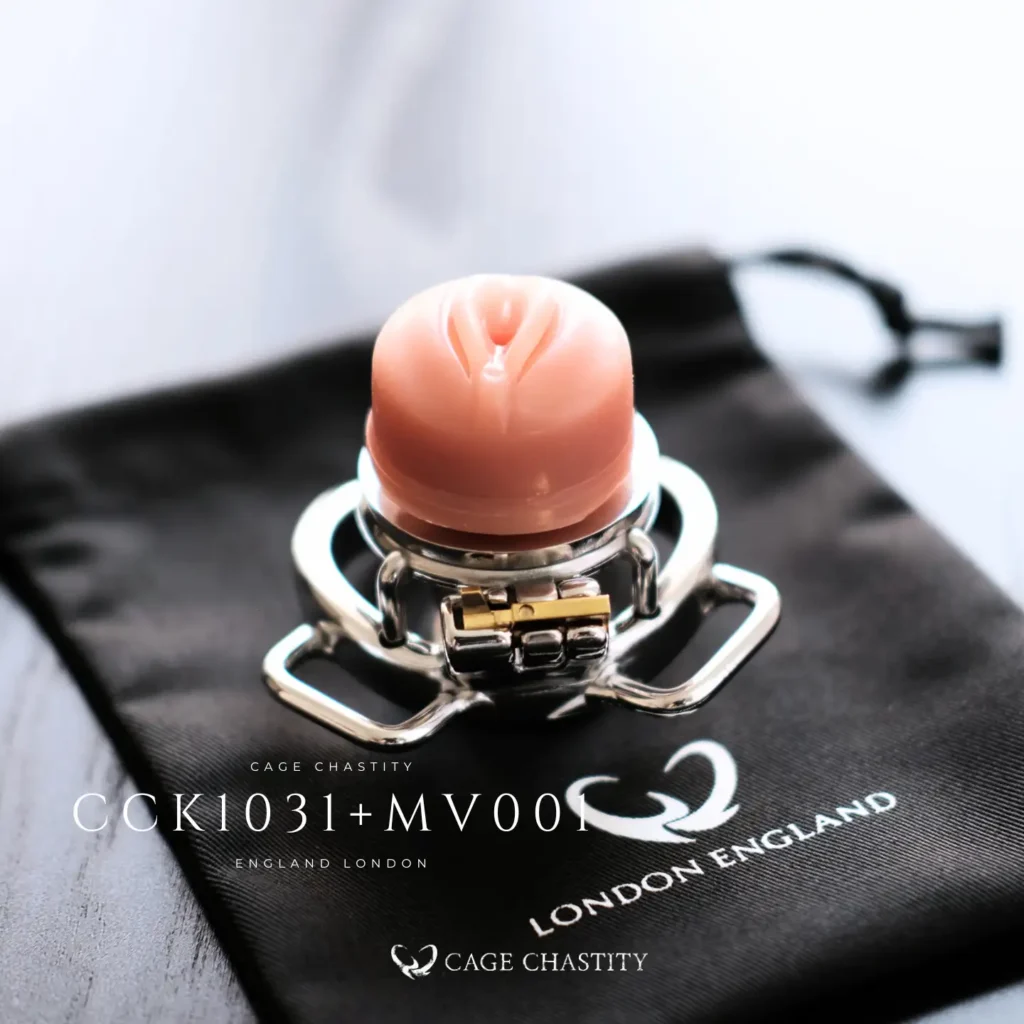
For an individual wearer, the cage may become that object. It might be the look of it, the feel of metal against the skin, or the image of seeing themselves locked in a mirror. The excitement does not always depend on someone else watching. It can come from the state itself — from being enclosed, restricted, or marked in a particular way. Just as some people are aroused by wearing leather, uniforms, or specific fabrics, others may find that the cage becomes part of their personal erotic focus.
In other situations, the fetish may belong more strongly to a partner. Many people understand this dynamic easily. For example, someone might feel especially attracted when their partner wears stockings or professional uniforms. The visual element becomes part of what excites them. In the same way, a dom may feel heightened arousal when seeing their sub locked. The cage becomes a visual and symbolic part of the shared dynamic.

Often, both elements exist at the same time. One partner may enjoy the symbolism, while the other enjoys the role or the attention it creates. The object then becomes part of a shared language between them.
A fetish does not automatically mean something extreme or unhealthy. Much of attraction is shaped by repetition and meaning. What matters is that it remains consensual, understood, and comfortable for everyone involved.
3.3 Intensifying the Experience
Beyond self-discipline and fetish, some people wear a cage for a very different reason: they want sex to feel stronger, not weaker.
You may have asked the same question we did at first — if a cage limits erection, wouldn’t that reduce arousal? Wouldn’t blocking desire make it fade?
Interestingly, after speaking with many of our customers over the years, we’ve found that for some people, the opposite is true. They don’t feel less, they actually feel more.

Sexual excitement isn’t only about intensity. It’s also about timing. The longer the build-up, the more powerful the release can feel. Think about being hungry but having to wait before eating. The waiting doesn’t kill the appetite. It often makes the first bite feel sharper and more satisfying. Anticipation changes the experience.
In neuroscience, there’s a concept called “reward prediction error.” In simple terms, the brain reacts strongly when there’s a gap between when you expect a reward and when you actually receive it. Delaying gratification increases that gap, and sometimes increases the impact.

A chastity cage creates exactly that kind of delay. It stretches the period of arousal instead of allowing immediate release. When release eventually happens, the contrast can make the experience feel more intense.
For this group, the goal isn’t restriction for its own sake. It’s shaping anticipation, and changing the rhythm of desire.
3.4 Identity and Relationship Structure
In certain dom/sub dynamics or FLR (female-led relationship) structures, some wearers choose to take on a managed role. This choice is voluntary, and for many, it brings a real sense of satisfaction. The pleasure here is not simply about pain or humiliation. It often comes from a change in mental state.
Neuropsychology has a concept called “transient hypofrontality.” In simple terms, when someone is deeply immersed in a clearly defined structure, the part of the brain responsible for constant planning and self-control becomes less active. In daily life, that part of the brain is almost always working.
Transient Hypofrontality: A temporary reduction in activity in the part of the brain responsible for planning and self-control. When this happens, people often report feeling less self-conscious and more absorbed in the moment. Research discussing immersive states—including intense focus, athletic flow, and sexual arousal—has suggested that this shift in brain activity may contribute to heightened presence and reduced internal judgment.
Arne Dietrich, Consciousness and Cognition.
Think about people with high-pressure jobs. They make decisions all day, solve problems, manage expectations. Eventually, they need to switch off. Sometimes that means staring out of a window, doing nothing, letting their mind drift. In those quiet moments, the constant internal voice slows down. There is relief in not having to decide anything.

For some people, entering a sub role feels similar. When the structure is clear and the rules are defined, they don’t have to direct everything themselves. Fewer decisions. Less internal debate. Self-awareness softens, and pressure often decreases. Many describe it as close to a “flow” state, where focus narrows and outside concerns fade.
For some, that mental shift is where the pleasure lies.
In this context, a chastity cage makes the rules physical rather than just verbal. It acts as a steady reminder of the chosen role. When structure is not only discussed but physically present, immersion becomes easier to maintain.
So the appeal of being a sub is not necessarily about suffering or shame. For some, it is about temporarily stepping away from constant self-management—and finding relief in a clearly defined role.
3.5 Orgasm Denial
This group may be the most unusual. They wear a cage not to avoid sexual pleasure, but to approach pleasure in a different way—by intentionally preventing orgasm.
Orgasm is a brief moment of release. Arousal, however, can last much longer. For some people, the most immersive part of the experience is not the release itself, but the build-up just before it.
“Zeigarnik Effect” suggests that unfinished tasks tend to stay active in the mind. Once something is completed, attention drops quickly. Orgasm works in a similar way. After release, the nervous system shifts into a recovery phase, and arousal decreases. When orgasm is intentionally withheld, that sense of completion never arrives. The experience remains open.
Zeigarnik Effect: The tendency for unfinished tasks to stay more active in our memory than completed ones. When something feels incomplete, the mind keeps returning to it. In discussions of arousal and anticipation, this idea is often used to explain why interrupted or delayed experiences can feel more intense than fully completed ones.
First described by Bluma Zeigarnik, later widely studied in cognitive psychology.
In this unfinished state, attention stays focused. Desire lingers near its peak. For some, the intensity of that threshold, the feeling of being close but not crossing it, is itself deeply satisfying.
In dom/sub dynamics, orgasm is often seen as one of the most personal forms of control. When a dom decides whether a sub is allowed to climax, the power structure becomes very clear. Being granted orgasm can feel like a reward; being denied can reinforce the chosen role. In this setting, pleasure does not come only from physical sensation, but also from the structure itself — from rules being followed and roles being affirmed.
In these situations, the experience becomes layered. There is the sustained arousal created by denial, and there is also the emotional connection that develops between dom and sub within a defined structure. For some wearers, both elements contribute to the overall appeal.
4. Understanding Doesn’t Mean It’s Right for You
In the previous chapters, we explored what chastity cages are and why some people choose to wear them. From self-discipline and intensified experience to identity structure, orgasm denial, and fetish, each motivation follows a psychological and behavioral logic that can be understood.
But understanding something does not automatically mean it is right for everyone.
Any arrangement that involves the body, relationships, and defined roles requires boundaries. A mature approach is not only about entering a structure. It is also about evaluating whether it fits, and knowing how to adjust if it no longer does. Before seriously considering wearing a cage, it is worth pausing to reflect on several areas: whether your motivation is clear, whether your body is comfortable, whether your relationship dynamic is stable, and whether the structure still feels positive in your current stage of life.

4.1 Clarifying Your Motivation
If you find yourself curious about chastity cages, there is no need to feel embarrassed about it. Exploring different kinds of experiences, whether physical, relational, or psychological, is part of adult life. What matters more is whether your motivation is clear.
People are drawn to wearing a cage for different reasons. Some want to explore delayed gratification. Some want to step into a defined role. Others want to change their relationship with impulse, or are simply curious. Different motivations lead to different experiences. What they should all have in common is that the choice is intentional and not driven by pressure or unmanaged emotion.
Before entering this kind of structure, two questions are especially important.
- Are you making this decision calmly and voluntarily, rather than out of fear of losing a relationship, trying to please someone, or acting on a temporary impulse?
- And do you understand the practical changes it may bring, including how it might affect your sexual rhythm, your expectations, and your interaction with a partner?
At its core, a chastity cage is a structure. Structure always implies rules and boundaries. Before stepping into any structure, being willing to accept its effects and knowing you can step out of it if necessary matter more than technical details.
4.2 Physical and Safety Considerations
A chastity cage is a device worn on the body. Anything worn for extended periods must be approached with comfort and safety in mind.
The most basic step is understanding how to measure yourself properly and how to choose the right size. We have a detailed guide on our site that explains sizing and fit in depth. In the beginning, it is normal to feel a slight sense of pressure as you adjust to wearing a cage. However, ongoing pain, numbness, swelling, discoloration, or signs of restricted circulation (blue balls) indicate that something is wrong. In those cases, the size or fit needs to be reconsidered. Physical signals should always take priority over rules or expectations.
Hygiene is another practical factor. A closed environment worn for long periods can increase the risk of skin irritation or inflammation. Regular cleaning and routine checks are important. Even for those who practice long-term wear, it is wise to remove the device periodically to inspect the skin and ensure everything remains healthy.
It is also important to be clear about one thing. Wearing a cage is not a test of endurance. It should never become an exercise in tolerating pain or pushing physical limits. If discomfort appears, adjusting or pausing is a responsible choice, not a failure. A chastity cage may be a structure, but the body is the foundation. No structure is worth compromising your health.
4.3 Alignment in Understanding
If wearing a cage involves only you, the rules are relatively simple. But in many situations, a chastity cage becomes part of a relationship structure. A partner may hold the key (key holder), unlocking times may be agreed upon in advance, or orgasm control may become part of the dynamic. At that point, the question is no longer only about the body or personal motivation. It becomes about the relationship itself.
Any arrangement that involves a distribution of power requires clear communication. Both people need to understand what the rules are, how long they apply, and under what conditions they can be adjusted or paused. Vague expectations often create more problems than clear limitations.
Reversibility is especially important. Voluntary submission means you choose to participate, and you also retain the right to stop. Ending the relationship should not lead to punishment, humiliation, or emotional pressure. If stepping away from the arrangement feels risky to the relationship itself, that is a sign that the dynamic may need to be reexamined.
It is equally important that both partners share an understanding of what the roles mean. Terms like dom/sub or FLR can carry different meanings for different people. For some, they represent play and ritual. For others, they reflect deeper identity structures. Without alignment in how these roles are understood, misunderstandings can easily develop.
Power structures create safety not because of control itself, but because boundaries are clear. When rules are the result of communication rather than unilateral decisions, the structure becomes stable. If this is not solely your decision, then a mature foundation always includes two elements: shared understanding and shared choice.
4.4 Periodic Reflection: Is It Still Right for You?
Any structure, once maintained over time, becomes more than a short-term experiment. It becomes part of daily life. A chastity cage is no different. It may bring novelty, immersion, or intensified experience at one stage, but that does not mean it will feel the same at every stage.
A mature practice includes periodic self-reflection. From time to time, it is worth revisiting the reasons you started. We suggest occasionally returning to this article as well and asking yourself a few simple questions. (we continue to update it with new insights and information)
- Does wearing a cage still feel positive?
- Is it still a voluntary choice?
- Does it remain comfortable both physically and mentally?
If the answers begin to feel uncertain, or if pressure starts to outweigh enjoyment, taking a pause is not a failure.
Roles, rules, and relationships evolve. Changes in work, stress levels, or personal circumstances can all affect how a structure feels. What once fit naturally may not always continue to do so.
Equally important is the ability to step away without damage. A healthy structure allows for adjustments in frequency, shorter cycles, or even stopping entirely, without harming self-respect or the stability of the relationship.
A chastity cage is not a vow. It is a chosen arrangement. It can be temporary or long-term, but it should never become an identity that cannot be reconsidered.
If you feel ready to begin your own chastity journey, we have also written a dedicated beginner’s guide that may be helpful.